

Sadly but truly, most home offices are an afterthought. Born out of necessity rather than planning. A desk squeezed into a spare corner, a chair that was never quite right, and walls so blank they could belong to anyone. It works, technically. But inspiring? Not even a little.
Most of us don’t know or even believe that your home office doesn’t have to feel like a waiting room you happen to pay rent for. With the right touches (and honestly, none of them are as complicated or as expensive as you might think), it can become the kind of space you actually look forward to sitting down in every morning. A space that reflects your personality, fuels your creativity, and makes the work feel a little less like work and more like an enjoyable hobby.
And that is exactly what the retro home office aesthetic does. It takes the bold colours, layered textures, and unapologetic personality of the late 80s and 90s and brings them into your modern workspace in a way that feels intentional, warm, and completely yours.
In this guide you will find everything you need to recreate this look from scratch — the colours, the furniture, the wall art, the lighting, and all the small details that pull it together into something that genuinely feels designed rather than assembled.
Whether you are starting with a completely bare room or refreshing a desk corner in your bedroom, there is undoubtedly something here you can action today without waiting for a bigger budget or a free weekend.
What Is the Retro Home Office Aesthetic, Exactly?
Before we delve any deeper, let’s first identify what this aesthetic is about. The retro home office aesthetic draws its energy from the visual language of the late 1980s and 1990s.
If you have been saving pins of bold, colourful, personality-packed workspaces and wondering what exactly ties them all together — this is it. Think deep navies, hot corals, golden yellows, and forest greens. Think bold typography on the walls, layered textures, and a confident mix of old and new that feels anything but accidental.
But here is what it is not. It is not about recreating a period-accurate office from 1994 or hunting down exclusively vintage furniture. Are we together? It is simply about borrowing a little spirit from that era. Things like the colour confidence, the maximalist layering, the refusal to be boring and filtering it through your current space and your current life.
This is an aesthetic that grows with you. You do not need to get it perfect on day one. Start with one bold print on the wall behind your desk or swap your plain desk lamp for something with more character. The retro home office aesthetic rewards layering over time, and that is part of what makes it so enjoyable to build.
The Colour Palette: Bold, Warm, and Unapologetic
If there is one thing that defines the retro home office aesthetic more than anything else, it is the colour. Not timid, not neutral, not “greige with an accent cushion”. We are talking about colours that commit.
Think about that deep navy that makes a wall feel like a statement, hot coral that warms an entire room, golden yellow that catches the light and holds it, forest green that grounds everything around it, and warm teal that ties the whole palette together without competing for attention.
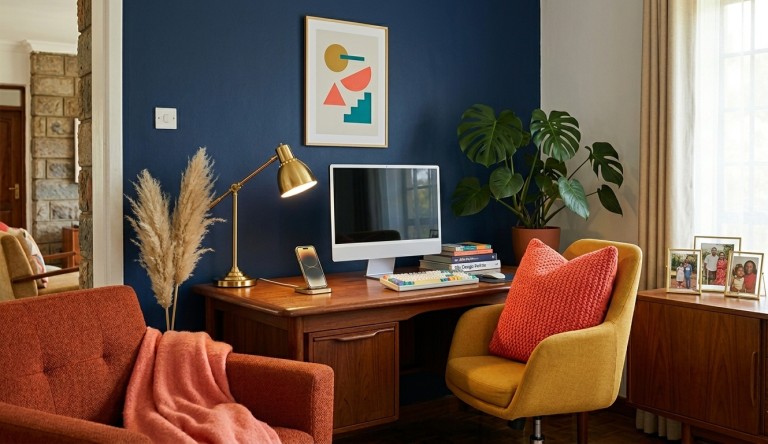
The good news is that you do not need to paint every wall in your home office a bold colour to bring this palette to life. Colour in the retro aesthetic works beautifully in layers. For example, a deep navy blue wall behind your desk paired with a coral throw pillow on your chair and a gold-toned lamp on the surface beside you. Three colours, three different elements, one completely cohesive look.
The formula that works consistently is this: choose one dominant dark anchor colour, one bold warm accent, and one metallic or warm neutral to tie them together.
Deep navy as your anchor, hot coral as your accent, and brass or gold as your connector. Or forest green as your anchor, golden yellow as your accent, and warm teal as your connector. These combinations work because they share the same high-saturation, high-contrast quality that made 90s design so visually memorable.
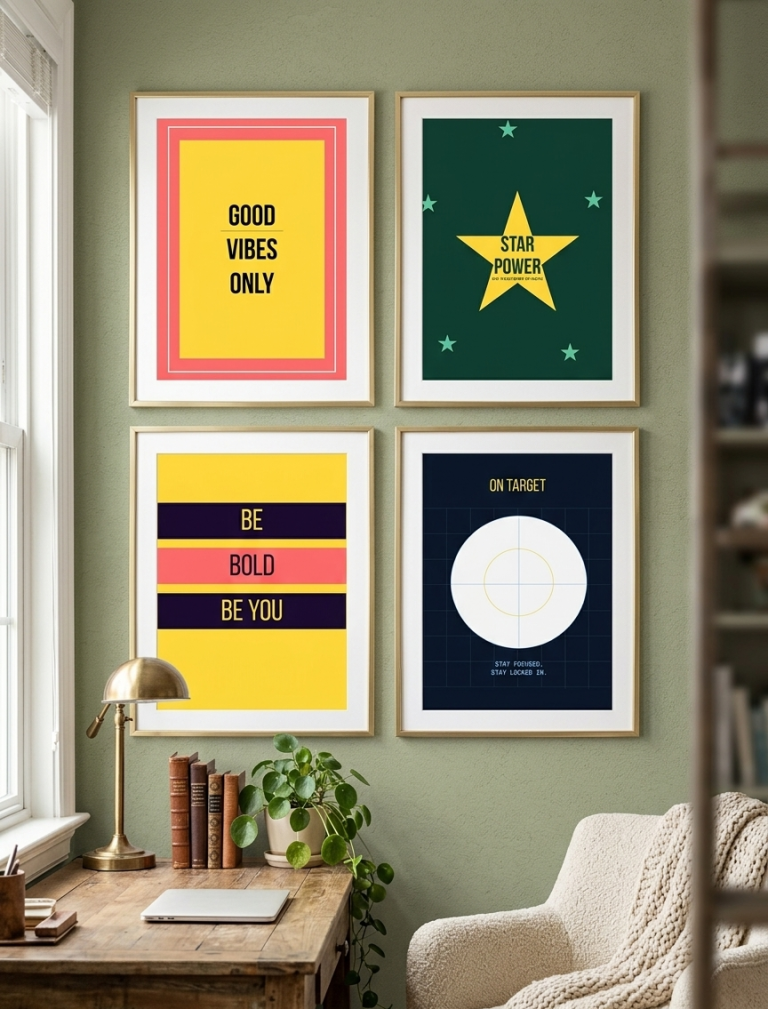
The wall art you choose also plays an enormous role in introducing this palette without requiring a single tin of paint. I designed the All That & A Wall 90s Maximalist Collection in exactly this colour family — deep navy, hot coral, forest green, gold, and teal — and every print in the bundle works together as a cohesive set.
Hanging two or three of these prints behind your desk instantly brings the retro palette into your workspace in the most effortless way possible. You can purchase the downloadable 8-print bundle on Payhip for only $11, or you can shop the individual prints and branded products (throw pillows, mugs, posters and tote bags) on Zazzle and have them shipped.
Start by just dipping your toes in this retro aesthetics journey to avoid getting overwhelmed. Pick your anchor colour first and buy one item in that colour before committing to anything else.
A deep navy desk mat, a forest green ceramic mug, or a coral cushion cover costs very little and tells you immediately whether that colour works in your specific space with your existing light. Getting the anchor right makes every subsequent decision easier because everything else is chosen in relation to it.
Furniture: Finding the Right Retro Desk Setup
Here is something most home office styling guides will not tell you: the desk itself matters far less than what surrounds it. Please read that again. Yes, the right retro desk makes a difference.
But a plain, unremarkable desk transformed by the right chair, the right lamp, and the right prints on the wall behind it will always outperform an expensive vintage desk sitting in a bare, unstyled room. So before you spend anything on new furniture, read this section to the end.
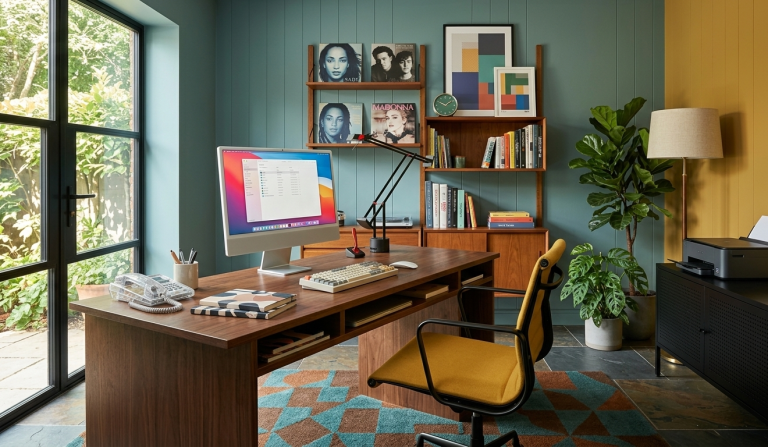
That said, if you are in the market for a desk that genuinely contributes to the retro aesthetic rather than just tolerating it, here is what to look for. Rounded edges rather than the sharp, angular lines of modern office furniture. Warm wood tones — oak, walnut, or dark mahogany — rather than the white or grey laminate that dominates most flat pack options.
A surface with some visual weight and character to it, even if it is not genuinely vintage. Mid-century writing desks, vintage school desks, and even repurposed dining tables all work beautifully in a retro home office context and can often be found secondhand at a fraction of the cost of buying new.
The chair, on the other hand, is where the aesthetic really announces itself. A bold coloured velvet chair — coral, mustard yellow, deep teal, or forest green — placed in front of even the most ordinary desk immediately signals that this workspace has a point of view.
Vintage typist chairs with their curved backs and swivel bases are perfect. Mid-century dining chairs repurposed as desk chairs work equally well. The key is colour and material — velvet, boucle, and leather all photograph beautifully and age in a way that synthetic office chair fabric simply does not.
Storage is the final furniture consideration and in a retro home office, open shelving will always serve the aesthetic better than closed cupboards. Visible books arranged by colour, vintage boxes stacked with intention, ceramic pots holding stationery, and framed prints propped casually against the back of a shelf all contribute to the maximalist layering that defines this look.
Save the closed storage for cables, equipment, and anything that does not contribute visually — keep it hidden and let everything worth looking at be seen.
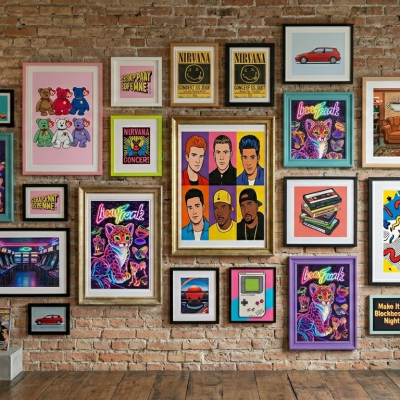
Wall Art and Gallery Walls: Where the Aesthetic Really Lives
If the furniture sets the stage, the wall art is the performance. Nothing, and I mean nothing, transforms a home office faster or more dramatically than what you put on the walls. You could have the most beautifully styled desk in the world, the perfect chair, the right lamp, and without something strong on the wall behind it the whole setup still reads as incomplete. Like a sentence that trails off before it makes its point.
The retro home office aesthetic lives on the walls more than anywhere else in the room. This is where the bold colours land, where the personality comes through, and where the difference between a workspace that looks designed and one that looks assembled becomes immediately obvious to anyone who walks in.
A gallery wall in a retro home office is a curated arrangement with a clear colour story. The starting point is always a hero piece — one large, bold print that establishes the aesthetic and the palette before anything else goes up. From there, you build outward, adding complementary pieces that reinforce rather than compete with the hero.
The types of prints that work best in this context are bold typographic designs, strong geometric shapes, retro colour block compositions, and graphic patterns with the high-contrast quality that defined 90s visual culture.
This is exactly the thinking behind the All That & A Wall 90s Maximalist Collection. Every print in the bundle was designed to work in a bold, retro-leaning workspace, and more importantly, to work together as a collection so you never have to wonder whether your prints will clash.
Dream Big in deep navy and gold makes a powerful hero piece above a dark desk. You Are That in coral, teal, and navy brings the three-colour energy that the aesthetic demands. These are just two of the 8 pieces in my 90s retro wall art bundle.
You can grab the complete 8-print bundle as an instant digital download on Payhip for $11 — print them at home or at a printing shop. If you would prefer physical products with the designs already printed and ready to hang, the individual posters, throw pillows, mugs, and tote bags from the collection are available on Zazzle. Either way, your walls will thank you.
Lighting: The Detail That Changes Everything
People will spend hours choosing the right desk, agonise over which prints to hang, rearrange their shelves three times, and then negate that whole process by illuminating the space with a harsh overhead light that drains every drop of warmth and personality out of the room. Do not be that person.
The right lighting does not just help you see, it transforms how the entire space feels. It is the difference between a room that looks like a corporate office that happens to be in your house and one that feels like a creative sanctuary you actually designed for yourself.
There are three layers of lighting every retro home office needs, and they work together rather than independently.
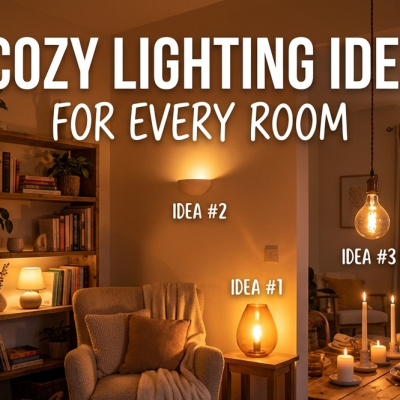
The first is ambient lighting — the overall room light that sets the base mood. In a retro aesthetic, this rarely means a harsh overhead fluorescent or a flat ceiling fixture switched on at full brightness. Warm bulbs at 2700K to 3000K are the starting point. Floor lamps positioned in corners and table lamps placed at eye level distribute warm light in a way that ceiling fixtures simply cannot replicate.
The second layer is task lighting, which is simply the desk lamp that does the actual work. This is one of the greatest opportunities in the entire retro home office setup to introduce a piece with genuine character. A vintage-style Anglepoise lamp in a bold colour. A classic banker’s lamp with its iconic green glass shade and brass base.
The third layer is accent lighting, the subtle glow that adds depth after dark and makes the space feel layered rather than flat. LED strip lights tucked behind open shelving cast a warm halo around your books and objects. A small neon sign in a complementary colour adds a playful 90s reference that works particularly well in a maximalist context.
These accent pieces are also consistently the most photographed elements in any retro home office setup — if you ever share your workspace on Pinterest or Instagram, the accent lighting is what makes the image feel alive.
Start by switching your existing bulbs to warm white 2700K before buying a single new lighting fixture. This one change, which costs the price of a pack of light bulbs, will immediately shift the mood of your entire home office toward the warmer, more atmospheric quality the retro aesthetic requires.
Mixing Vintage and Modern: Getting the Balance Right
Let’s address the mistake that turns a beautifully intentioned retro home office into something that feels more like a storage unit for old things rather than a designed, creative workspace. Going too far. A room full of nothing but retro pieces is not a retro aesthetic. It is a time capsule.
The retro home office aesthetic works precisely because of contrast. The tension between clean modern lines and bold retro personality is the whole point. Remove the modern elements, and you remove the contrast. Remove the contrast, and you lose the aesthetic entirely.
The three pairing principles that work consistently are worth understanding clearly before you make a single purchase or styling decision.
The first is modern furniture with retro accessories. This is the most practical starting point and the one that delivers the most immediate visual impact for the least investment. Keep your furniture contemporary, then let the accessories carry the decade entirely. The prints on the wall, the lamp on the desk, the cushion on the chair, the mug on the surface, these are where the 90s live!
The second principle is retro colours in a modern layout. A maximalist colour palette does not require a maximalist amount of stuff. o aesthetic in a room with very little floor space and almost no clutter.
The third principle is one hero vintage piece surrounded by a modern context. A single genuinely vintage or vintage-style item — a classic typewriter used as a decorative object on a shelf, a rotary telephone sitting beside your monitor as a visual reference rather than a functional one — immediately anchors the retro aesthetic without requiring the whole room to follow suit.
Textiles and Soft Furnishings: Adding Warmth and Depth
If you have ever looked at a beautifully styled home office photo and felt that warm, almost physical pull toward the space, textiles are almost certainly the reason why. Not the desk. Not the wall art. Not even the lighting. The textiles. The throw blanket draped over the chair back. The throw pillow in that specific shade of mustard yellow.
Textiles do something in a room that no other design element can replicate; they add warmth that the eye reads before the brain processes it. This is why spaces styled with beautiful hard surfaces but no soft furnishings so often feel cold and unwelcoming in photographs, regardless of how objectively well-designed they are.
The rug is where the room comes together at floor level, and in a retro home office, it should be treated as a design decision rather than an afterthought. A bold patterned rug in warm tones introduces visual complexity at floor level that balances the wall art above and creates a sense of the room being designed from floor to ceiling rather than just from the desk up. A solid colour rug in your dominant palette tone is always the right decision over no rug at all.
Plants and Natural Elements: Softening the Boldness
There is a moment in every well-styled retro home office where everything comes together, and yet something still feels slightly off. Nine times out of ten, that missing element is a plant.
Plants do something in a bold, maximalist space that nothing manufactured can replicate. A room full of bold colours and strong graphic patterns needs that organic counterpoint more than a neutral room does, because the bolder the designed elements are, the more the eye craves something that did not come from a design decision.
A trailing golden pothos catching the warm light from a desk lamp echoes the gold tones in your wall art. A rubber plant in a deep terracotta pot beside a coral accent wall creates a colour harmony that feels like it was planned, even when it emerged entirely naturally from putting living things in a room that already had the right colours on its walls.
The plants that work best in a retro home office context are worth choosing with some intentionality rather than simply buying whatever is available at the nearest garden centre. A trailing pothos or philodendron placed on a high shelf and allowed to cascade downward adds vertical movement to the space and draws the eye upward in a way that makes the room feel taller.
The ceramic pot or planter deserves as much consideration as the plant itself in a retro home office context. A beautifully shaped plant in a plain plastic nursery pot is a wasted opportunity. The pot is a design object and in a retro maximalist space it should be treated as one. Dark glazed ceramics, terracotta in warm earth tones, and bold, solid colour planters in coral, teal, or mustard yellow all work beautifully within the retro palette and are widely available at accessible price points.
The Finishing Touches: Small Details That Make It Feel Complete
The difference between a home office that looks good and one that stops people mid-scroll on Pinterest, makes them save the image immediately, and sends them searching for every product in the frame is rarely the big things.
It is the small things. The details so specific and considered that they could only have been chosen by someone who genuinely cared about the space down to its last corner. The finishing touches that nobody notices individually but everybody feels collectively as the quality that separates a designed room from a decorated one. Many of them cost nothing at all beyond the time it takes to make a deliberate decision rather than leaving something to chance.
Books are the finishing touch that the retro home office aesthetic was practically invented for. Not books hidden in closed storage or stacked in random piles, but books chosen and arranged with genuine curatorial intention. A stack of three or four books with visually interesting spines on the desk surface. In a retro maximalist home office, books are never just reading material; they are part of the room.
Personal objects are the finishing touch that no styling guide can prescribe, but every beautifully finished room includes. A framed photograph of somewhere that matters to you. A souvenir from a trip that changed how you think about something. The personal objects are what make it yours specifically, rather than anyone else’s version of the same aesthetic.
Your Retro Home Office Is Closer Than You Think
The retro home office aesthetic is not a project that requires a complete renovation, an unlimited budget, or a professional interior designer making decisions on your behalf. It is a collection of intentional choices made one at a time, layered gradually over weeks and months, each one building on the last until the room around you reflects exactly the kind of creative, bold, personality-driven workspace you have been saving to your Pinterest boards for longer than you probably care to admit.
What I hope this guide has shown you is that the gap between the retro home office of your imagination and the one you actually live and work in every day is smaller than it appears from the outside. It is not a gap measured in money, time or access to the right shops.
The retro aesthetic rewards patience and intentionality in equal measure. The most beautifully styled retro home offices you have saved on Pinterest were almost certainly not created in a single weekend. They were built gradually, piece by piece, decision by decision, by someone who started exactly where you are now — with a clear vision, a starting point, and the willingness to begin.
*I designed and sell all the products recommended in this article through my Zazzle shop. This post contains self-promotion links — I earn a royalty and a referral commission if you purchase through them, at no extra cost to you*
AgasHome
This is a space where we strive to make your lives easier. We're helping you to create cosy, organised homes through simple kitchen systems, home resets & lifestyle habits. We share, learn, educate and have fun!